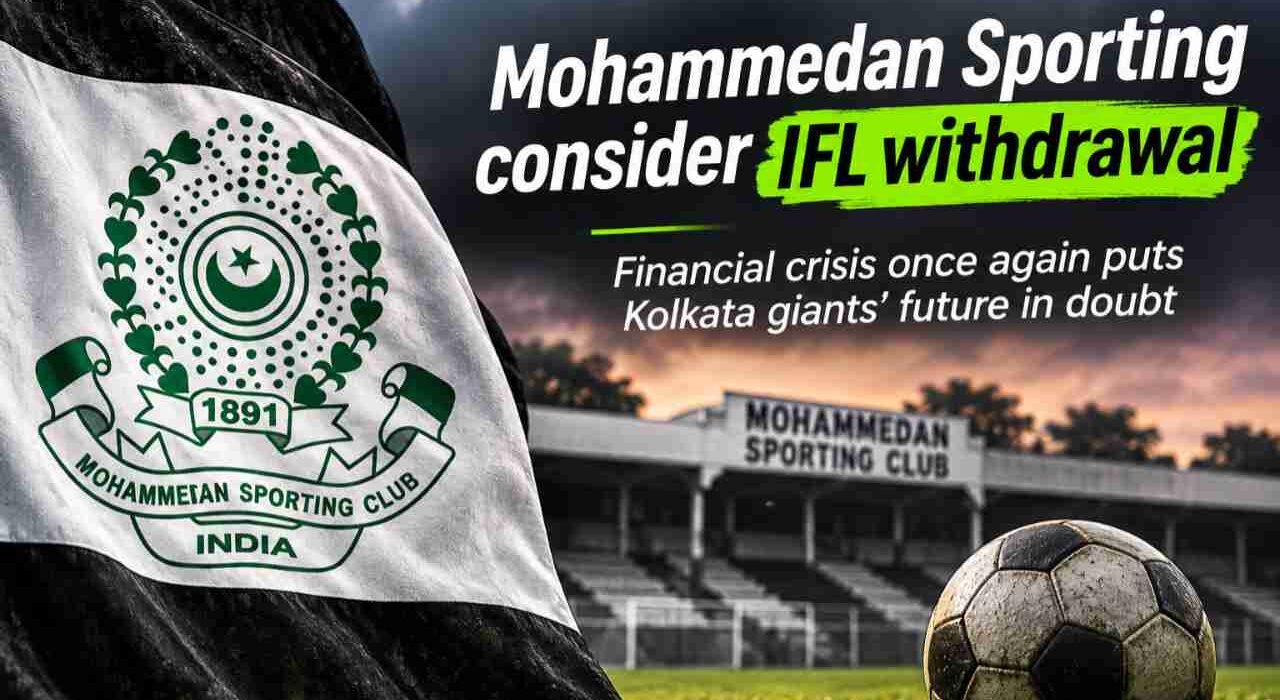
Financial uncertainty continues to haunt Mohammedan Sporting as the Kolkata giants consider an early IFL exit, highlighting deeper concerns over their management, investment and long-term sustainability.
November 28: For a club that has witnessed generations of footballers, celebrated some of the biggest moments in Indian football and carried the hopes of an entire community, the present has been far removed from its glorious past. Mohammedan Sporting’s struggles over the last few years have rarely allowed the club a moment to settle. From management changes and financial disputes to relegation from the Indian Super League, the century-old Kolkata club has been fighting one battle after another. And just when there appeared to be some movement towards stability, another difficult situation has emerged.
Mohammedan Sporting are now considering withdrawing from the ongoing Indian Football League, barely four matches into the competition. The development has once again brought the club’s financial condition into focus, raising questions about how it intends to sustain its football operations when even fulfilling the immediate requirements of a league campaign has become a challenge
The Black and White Brigade’s start to the campaign has been disappointing. After four matches, they are yet to open their account, having conceded 13 goals and sitting at the bottom of the standings. However, their struggles on the pitch are only part of a much bigger problem. The club’s financial condition has reportedly made it increasingly difficult to sustain its participation in the competition.
The change in management earlier this year, with Wasim Akram returning as general secretary and Ghazal Uz Zafar taking over as president, had raised hopes of a fresh beginning. The new leadership reportedly cleared some outstanding dues and provided financial assistance to keep the club operational. However, the accumulated liabilities and recurring expenses have continued to put pressure on the administration.
Even the availability of Kishore Bharati Krirangan as a free home venue, following the West Bengal Sports Minister’s announcement, has not been enough to resolve the larger financial concerns. While the waiver of ground charges provides some relief, conducting a match involves several other expenses, including security, logistics and matchday arrangements. Away fixtures add further costs through travel, accommodation and other team-related requirements. For a club already struggling with pending payments, maintaining an entire league campaign has become a difficult proposition.
Perhaps the biggest concern is Mohammedan Sporting’s inability to establish a sustainable financial arrangement. Modern football clubs increasingly depend on investors and commercial partnerships to manage their operations. However, investment requires clarity over ownership, shareholding, financial commitments and the long-term control of the club.
Mohammedan’s previous investor arrangements and disagreements over ownership and share transfers have complicated that process. Financial assistance can help meet immediate expenses, but it cannot replace a structured investment model. The new administration’s efforts have provided some breathing space, yet the club continues to face the challenge of finding dependable financial backing.
The latest decision reportedly emerged after a management meeting on Friday, November 27. At the time, the players had not been formally informed, while official communication to the All India Football Federation (AIFF) was still awaited. Therefore, the management’s reported decision and a formal withdrawal remain two different things.
What does an IFL withdrawal mean?
Under Section 4.4.1 of the AIFF Indian Football League Regulations 2026–27, withdrawing after the commencement of the competition carries serious consequences.
All matches played and yet to be played by the withdrawing club will be rendered null and void. Its previous results will be removed from the standings, with the points and goals from those matches excluded while determining league rankings.
The financial consequences could be equally significant. The club will be liable to compensate other participating clubs, AIFF, its commercial rights partner, licensees, broadcast licensees and member associations for damages or losses suffered. AIFF will determine the compensation amount.
Furthermore, the club will automatically be disqualified from the continued edition and any future edition of the competition. Depending on the gravity of the situation, AIFF may extend the suspension to the next two editions. Additional fines and disciplinary sanctions are also possible, and the club must return any financial stipends received from AIFF in relation to the competition.
For the other teams, Mohammedan’s withdrawal would also mean the removal of their results against the Kolkata side, potentially changing the entire points table.
The possibility of leaving the IFL after just four matches raises a bigger question about Mohammedan Sporting’s future. Relegation from the ISL was supposed to be a setback from which the club would rebuild and fight its way back. Instead, the financial uncertainty has followed them into the second division.
The immediate concern is not just the club’s participation but also the players, coaching staff and employees whose salaries and contractual commitments cannot be overlooked.
For a club with such a rich footballing legacy, temporary financial assistance and repeated management changes cannot be the long-term answer. Mohammedan Sporting need a sustainable investment structure, financial transparency and an administration capable of planning beyond the next fixture.
The Black and White Brigade have endured several difficult chapters in recent years. But this latest uncertainty is particularly worrying: the battle is no longer just about returning to the top division, but ensuring that one of Kolkata’s oldest football institutions can afford to remain in the game.
Read more about Indian Football