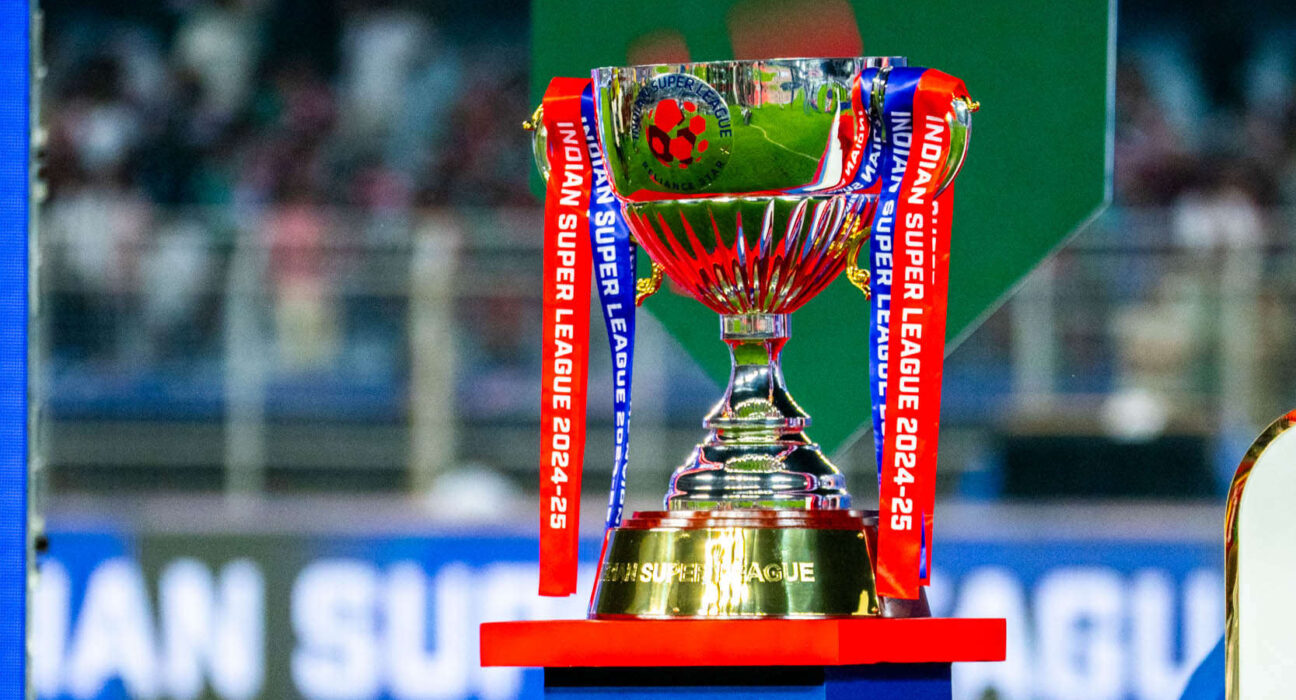
Kolkata, September 5: The Indian Super League (ISL) is entering uncharted territory.
The country’s top-tier football competition will kick off its 2026–27 season on October 10, but this will be far more than the beginning of another campaign. The new season marks the start of what the league describes as a historic club-led era, with participating clubs taking greater control over the direction and decision-making of the competition.
The season will also bring back the traditional home-and-away format, restore the playoff race, introduce a clearly defined distinction between the ISL Shield Winners and the ISL Cup Champions, and reaffirm the country’s promotion-and-relegation principle.
With 163 matches scheduled across eight months, the 2026–27 season promises to be one of the longest and most structurally significant campaigns in the history of Indian football’s top division.
But behind the fixtures and the headline announcements lies a much bigger question: what does the new ISL actually want to become?
October 10 marks the beginning of a new ISL
The 2026–27 ISL season will begin on October 10 and continue until May 2027.
Unlike the recent editions of the competition, the league will be played in a traditional home-and-away round-robin format, giving clubs the opportunity to play one another both at home and away.
The format is important not simply because it increases the number of meaningful matches, but because it restores a fundamental characteristic of a conventional league competition: consistency over an extended campaign.
The team that finishes at the top of the league table after the league stage will be crowned the Shield Winners, described officially as the champions of the ISL.
That team will also earn a place in Asian competition.
The change gives the league-stage table a much greater sporting significance.
There will no longer be a question about whether finishing first is merely an advantage heading into a postseason competition. The team that demonstrates the greatest consistency over the league campaign will officially be recognised as the ISL champion.
At the same time, the season will not end with the league table.
The playoffs are back.
The return of the playoffs
The 2026–27 season will see the return of the playoff system, with the top six clubs qualifying for the postseason battle to become the ISL Cup Champions.
This creates a two-tier championship structure.
The league stage will determine the Shield Winners and official ISL champions, while the playoffs will crown the Cup Champions.
It brings back an element that has been central to the ISL’s identity since its early years: the knockout drama of a postseason championship.
For clubs, that creates two separate objectives.
The first is to finish at the summit and claim the Shield.
The second is to finish inside the top six and give themselves a chance of winning the Cup.
The distinction could make the league table particularly fascinating during the second half of the season.
A club sitting outside the top two or three may no longer be chasing only continental qualification or a higher league position. Its immediate objective could simply be to remain inside the top six and secure a playoff place.
That potentially creates a much more competitive race across the table.
Shield versus Cup: two different definitions of success
The new structure also creates an interesting philosophical distinction within Indian football.
What constitutes being the “best” team?
Under the new system, there are two possible answers.
The Shield will reward consistency.
Over the course of a long home-and-away campaign, the team finishing first will have accumulated the most points and demonstrated the strongest sustained performance.
The Cup, on the other hand, will reward performance under knockout pressure.
The top six teams will enter the playoff race with the opportunity to finish the season as Cup Champions.
That means the ISL will effectively have two different competitive narratives.
One will be about the marathon.
The other will be about the sprint.
And both will carry significance.
For clubs, squad management will therefore become increasingly important. A team that dominates the league stage must still negotiate the postseason if it wants to add the Cup to its season.
Conversely, a team that does not finish at the top of the table can still end the campaign with silverware.
A club-led era
Perhaps the biggest announcement, however, is not the format.
It is the ownership of the league’s direction.
The 2026–27 ISL is being described as the beginning of a club-led era, with the participating clubs coming together with the All India Football Federation to steer the league towards a new direction.
According to the announcement, the club-led model will give teams greater control over decisions and the future direction of the competition.
That represents a significant conceptual shift.
For years, discussions around Indian football have frequently centred on the relationship between clubs, the federation, the league and the wider football ecosystem.
The new model attempts to put the clubs closer to the centre of that ecosystem.
The stated objective is not simply greater control for clubs.
It is to build a more comprehensive football calendar, increase investment in Indian players and create a stronger and more sustainable football ecosystem.
Those objectives will ultimately have to be judged by what happens on the ground.
If the club-led model succeeds, it could potentially create stronger commercial incentives, better long-term planning and greater investment in infrastructure and Indian footballing talent.
But the responsibility will also be considerably greater.
With greater control comes greater accountability.
A test of collective responsibility
The club-led model could be one of the most important experiments in Indian football.
The clubs now have a larger role in shaping the competition they themselves participate in.
That means disagreements between individual clubs and the collective interests of the league will inevitably become important.
A sustainable league cannot be built around short-term interests alone.
The clubs will need to think beyond individual seasons.
They will have to consider issues such as player development, commercial growth, match-going audiences, broadcasting, scheduling, infrastructure and the overall competitiveness of Indian football.
The press release specifically identifies greater investment in Indian talent as one of the objectives of the new model.
That could become one of its most important tests.
India’s football ecosystem has long struggled to convert the popularity of the professional game into a sufficiently deep player-development system.
If the club-led ISL genuinely increases investment in Indian players and creates stronger pathways for domestic talent, the change could eventually have consequences well beyond the league itself.
Thirteen teams, with one participation still conditional
As things stand, 13 teams are listed for the 2026–27 competition.
They are:
- Bengaluru FC
- Chennaiyin FC
- Churchill Brothers FC
- East Bengal FC
- FC Goa
- Inter Kashi FC
- Kerala Blasters FC
- Mohun Bagan Super Giant
- Mumbai City FC
- NorthEast United FC
- Odisha FC
- Punjab FC
- Sporting Club Delhi
However, Churchill Brothers’ participation remains subject to regulatory approvals.
That means the final composition of the league is not entirely settled yet.
Churchill Brothers’ potential involvement is particularly significant in the context of the league’s stated promotion-and-relegation principle and the wider attempt to create a more open competitive structure.
Diamond Harbour’s extraordinary situation
One of the most unusual aspects of the announcement concerns Diamond Harbour FC.
The club earned promotion to the ISL after winning the 2025–26 Indian Football League.
However, Diamond Harbour failed to fulfil the administrative fee requirement for the 2026–27 season and consequently did not take up its promoted slot.
The consequences are unusual.
In keeping with the league’s promotion-and-relegation principle, Diamond Harbour will not be eligible to earn any points during the season and will, by default, be placed at the bottom of the table.
The club will also not retain ISL status for the 2027–28 season and will compete in the Indian Football League that season.
It is an extraordinary situation because Diamond Harbour effectively occupies a place in the competitive framework without being eligible to compete for points.
The decision nevertheless demonstrates that the league is attempting to maintain a link between its top division and the wider Indian football pyramid.
Promotion and relegation return to the centre of the conversation
The Diamond Harbour situation also highlights the importance of the promotion-and-relegation principle.
For a national top division to function as part of a football pyramid, there must be sporting consequences attached to performances at both ends of the table.
The new ISL framework appears to be moving more explicitly in that direction.
Promotion gives ambitious clubs from the lower level a pathway into the country’s top division.
Relegation ensures that established ISL clubs cannot assume permanent membership.
That can fundamentally alter the competitive psychology of the league.
For clubs at the bottom of the table, matches in March, April or May can carry enormous consequences.
A mid-table club may be chasing a playoff position.
A leading club may be chasing the Shield.
A struggling club may be fighting simply to preserve its top-flight status.
That creates a much wider range of competitive incentives.
Sporting Club Delhi adds another dimension
The participation of Sporting Club Delhi also adds to the evolving identity of the competition.
The ISL has steadily expanded beyond the traditional footballing centres that defined the early years of India’s professional era.
The presence of clubs from different regions is important if the competition is to establish itself as a genuinely national league.
A stronger geographical spread can potentially create new markets, new rivalries and new football audiences.
But merely adding clubs is not enough.
The challenge will be ensuring that those clubs develop sustainable sporting and commercial structures capable of competing at the highest level.
163 matches and eight months of football
The 2026–27 season will feature 163 matches across eight months.
That is a substantial commitment for clubs, players, broadcasters, stadium operators and supporters.
It also raises the importance of scheduling.
A longer competition means greater demands on squad depth.
International windows, domestic cup competitions, continental commitments and player availability will all become increasingly important variables.
For India’s leading clubs, the challenge will be even greater.
Clubs competing in Asian competitions could potentially face a demanding combination of domestic league fixtures, playoffs, domestic cups and continental football.
Squad construction will therefore matter enormously.
A team cannot expect to survive an eight-month campaign with a short squad.
The implications for Indian players
One of the most important promises attached to the new club-led model is greater investment in Indian talent.
This deserves particular attention.
The ISL is now established as the country’s top professional competition, but the long-term strength of Indian football will ultimately depend on the quality and depth of Indian players.
A sustainable league should not simply provide employment opportunities for established domestic footballers.
It should create an environment in which young Indian players can develop into high-level professionals.
The coming years will therefore be an important test of whether the new model produces measurable investment in player development.
Will clubs develop more young players?
Will academy systems improve?
Will Indian players receive greater responsibility?
Will more young footballers get consistent minutes?
Will the gap between established Indian internationals and emerging players begin to narrow?
These are the questions that will determine whether the structural changes have produced genuine footballing progress.
East Bengal, Mohun Bagan and the Kolkata factor
For Kolkata football, the new season carries its own significance.
East Bengal FC and Mohun Bagan Super Giant will once again be part of the national top division, ensuring that one of Indian football’s most historic rivalries remains central to the ISL narrative.
The Kolkata derby has become one of the competition’s marquee fixtures and continues to represent the connection between India’s traditional football culture and its modern professional league structure.
The two clubs will enter the season with ambitions beyond simply qualifying for the playoffs.
For clubs of their stature, the expectation will naturally be to compete for the Shield and Cup.
The return of the traditional home-and-away format should also add another dimension to the rivalry.
Home advantage, away performances and the atmosphere around individual stadiums could become increasingly important across the season.
What this means for the ISL’s identity
The biggest question surrounding the 2026–27 season is ultimately about identity.
The ISL began as a competition designed to accelerate the growth of professional football in India.
Over time, it became the country’s leading league competition.
Now it is attempting to evolve again.
The club-led structure suggests a move towards greater institutional maturity.
The home-and-away format strengthens the traditional league identity.
The Shield gives the league-stage table greater sporting value.
The return of the playoffs preserves the knockout spectacle.
Promotion and relegation connect the ISL more closely to the wider football pyramid.
And the emphasis on Indian talent potentially gives the competition a stronger developmental purpose.
Taken together, these changes represent a significant attempt to redefine what the ISL is.
The real challenge begins after October 10
Announcements and formats, however, are only the beginning.
The success of the new era will not ultimately be determined by the press release.
It will be determined by what happens over the next eight months.
Can the clubs work collectively?
Can they make long-term decisions rather than short-term ones?
Can the league deliver a commercially sustainable model?
Can it increase stadium attendance?
Can clubs invest more heavily in Indian players?
Can the competition maintain sporting integrity?
Can the promotion-and-relegation principle become a meaningful part of the Indian football pyramid?
And perhaps most importantly, can the ISL develop an ecosystem in which clubs are financially and institutionally strong enough to sustain professional football for decades rather than merely seasons?
Those questions will define the club-led era.
A potentially defining season for Indian football
The 2026–27 ISL season arrives at a particularly interesting point in the development of Indian football.
The competition is no longer an experiment.
It is no longer simply attempting to establish professional football as a commercial product.
It now has to demonstrate that it can build a sustainable football ecosystem.
The 163-match season beginning on October 10 will therefore be watched for much more than the identity of the Shield winner or Cup champion.
It will be a test of the new relationship between the clubs and the AIFF.
It will be a test of the league’s commitment to its promotion-and-relegation principle.
It will be a test of whether Indian talent receives greater investment.
And it will be a test of whether the clubs themselves are ready to take responsibility for the future they have been given greater control over.
For supporters, there will be the familiar excitement of league football, rivalries, title races and playoffs.
For Indian football, however, the stakes are considerably bigger.
October 10 will not simply mark the opening of another ISL season. It will mark the first chapter of a new experiment in how India’s top football league is run, structured and ultimately built for the future.
And by May 2027, Indian football will have a much clearer idea of whether that experiment has worked.
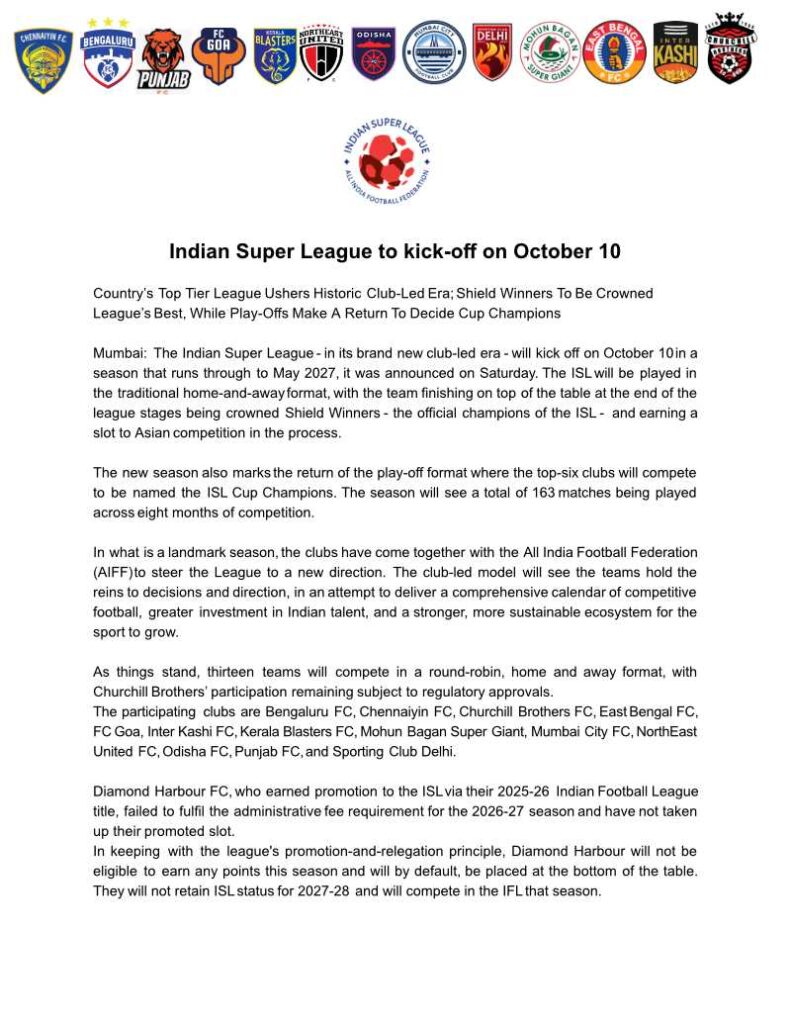
Official Statement
Read more about Indian Football